Unlock Your Leadership Potential
Discover the UF Leadership Competency Model, a valuable resource for navigating the complexities of management at the University of Florida. Explore this model to reflect on your achievements and areas for potential growth. Take advantage of our leadership development programs tailored to help you cultivate these competencies and achieve excellence in leadership.
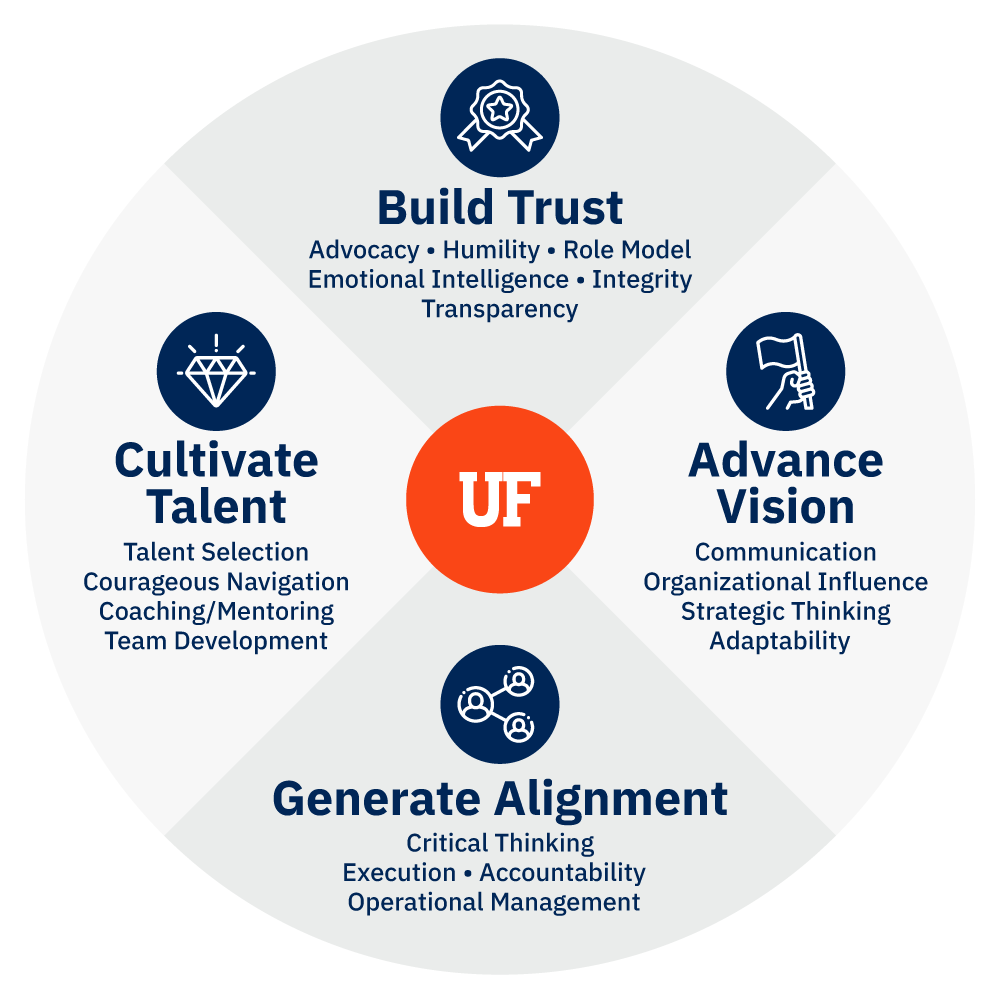
Competencies Explained
With four key quadrants—Build Trust, Advance Vision, Generate Alignment, and Cultivate Talent—this model outlines crucial leadership skills and behaviors. Access UF Training and Organizational Development’s Leadership Development Toolkit, providing tailored resources like job aids and podcasts to support your leadership growth. Unlock your potential and excel as a leader at UF.
 Build Trust
The ability to actively champion or influence an idea or position when needed; demonstrate support for faculty, staff, and organizational interests
- Extends trust to others
- Conveys confidence in employees’ ability to be successful, especially at challenging new tasks
- Supports and promotes faculty and staff interests
- Understands and facilitates the tenure, promotion, and permanent status process
- Supports fair treatment and opportunity for all
- Challenges practices or policies that may be exclusionary
- Speaks out on issues of concern to the organization in order to exert influence on decisions affecting the university
- Supports and promotes organizational interests
- Takes the lead and champions an idea or position
The genuine ability to relate to all people; unpretentious, polite, sharing credit, unafraid to admit mistakes
- Is approachable
- Shares credit
- Admits mistakes
- Shows respect for others
- Willing to sacrifice personal goals for organizational goals
- Realizes that personal success is connected to team success
The ability to lead by behavior and example that others can emulate
- Exemplifies professional behavior and image
- Shows loyalty
- Maintains consistency between words and actions
- Honors commitments
- Admits mistakes
- Possesses and applies technical knowledge and skills needed to make decisions and perform at a high level
- Stays current on practices and trends in area of expertise and plans, responds accordingly
- Sets and demonstrates high professional standards
- Is sought out as a resource to provide advice or solutions
- Leads by example
The skill of perceiving, understanding, and managing emotions and feelings effectively
- Knows self
- Recognizes and considers the impact of own mood, biases, convictions, and behavior on others
- Seeks to listen and understand others’ feelings and perspectives, and responds accordingly
- Builds rapport with others
- Hears, accepts, and integrates feedback from others
- Controls and filters emotions in a positive way
- Effectively manages relationships
- Displays optimism and seeks alternatives when facing challenges
- Creates routines to manage stress
- Reacts appropriately-doesn’t over- or under-react to a situation
Adhering to moral and ethical principles; soundness of character
- Maintains and fosters ethical behavior in all business activities and decisions
- Gives consideration to the rights and viewpoints of others
- Strives to do the right thing without prompting
- Acts in a manner that is fair, forthright, and honest
- Keeps confidences
- Models and reinforces ethical behavior in self and others
- Builds trust at all levels of the organization
- Follows through on commitments
- Carries their share of the workload
- Perceived as responsible, reliable, trustworthy
- Reliably maintains confidential and sensitive information
The ability to clearly explain decisions and the process or motivations involved
- Tells the truth
- Admits and fixes mistakes promptly
- Provides accurate information in a timely manner
- Makes decisions publicly, when possible, to instill trust
- Facilitates access to information
- Explains decisions
- Ensures that motives are clear (no hidden agendas)
- Uses discretion when necessary
 Advance Vision
The ability to listen actively; to impart thoughts, views, information, and ideas persuasively and adaptively
- Clearly and effectively expresses thoughts, information, views, and ideas using both formal and informal methods
- Ensures minority opinions are heard
- Actively listens to others
- Maintains an open-door policy
- Adjusts style and format based on audience
- Regularly invites dialogue with and candid feedback from others
- Masters multiple methods to convey information
- Ensures key issues are addressed
- Delivers information quickly and effectively up, down, and throughout the organization
- Plans and delivers communications that are impactful and persuasive
- Delivers proactive communications on key issues
- Articulates a shared vision
- Creates a compelling and inspirational picture of the future
- Maintains visibility
The ability to shape decisions, behaviors, or outcomes within the organization
- Understands the formal and informal workings of the organization
- Understands and interprets internal and external forces affecting the job
- Knows organization’s mission, history, stakeholders, and customers
- Knows the “pace of business”
- Understand how the organization operates, its goals, and the external factors that influence the success of the organization
- Uses tacit knowledge
- Uses the pace of work to achieve goals
- Understands the political climate and operates effectively within the climate
- Seeks and incorporates diverse stakeholders’ interest
- Understands the components of change management and able to lead the team through the process of change
- Communicates effectively about the reasons for change, provides support and resources, and manages the transition process to ensure successful implementation
- Addresses resistance to change
- Understands the importance of interdisciplinary collaboration to address complex issues.
- Creates opportunities for cross-department dialogue, brainstorming, and problem-solving.
- Builds strong relationships and partnerships between departments
The ability to clarify and articulate direction, priorities, and a shared vision
- Fosters an ongoing dialogue about the team’s vision and purpose
- Develops and communicates goals that align with the organization’s vision and purpose
- Sets clear expectations and establishes a course of action to achieve goals
- Sets priorities
- Thinks proactively
- Anticipates and prepares for roadblocks
- Builds an inspirational and compelling shared vision and sense of core purpose
- Fosters an ongoing dialogue about the organization’s vision and purpose
- Seeks out diverse perspectives when developing strategy
- Analyzes the organization’s position relative to similar institutions and develops strategy based on current position
- Creates a climate of creativity to achieve organizational goals
- Understands how vision and purpose in other areas of the organization interrelate with own area
- Inspires the broader organization to share their vision
The ability to adjust in response to changing circumstances
- Demonstrates a willingness to adjust plans or approaches in response to changing circumstances
- Uses challenges and setbacks as opportunities to learn and improve
- Creates an environment where experimentation and innovation are encouraged
- Seeks and listens to feedback from diverse perspectives
 Generate Alignment
The ability to analyze, evaluate, and interpret information to make informed decisions or form reasoned conclusions.
- Learns from mistakes
- Knows when to speak and when to listen
- Can perceive climate and respond accordingly
- Understands the impact and implications of decisions
- Weighs costs, benefits, risks, and possible rewards when assessing a situation
- Makes timely and sound decisions
- Addresses a problem by using a logical, systematic, sequential approach
- Uses facts and available information to develop logical assumptions
- Recognizes discrepancies and inconsistencies between facts and/or data
- Draws correct inferences from information
- Asks good questions and probes all sources of answers and feedback
- Recognizes the appropriate problems to work on
- Marshals resources needed to work on a problem
- Looks for creative and innovative solutions
- Knows when to close a discussion and move to a decision
- Seeks and values input from diverse groups when making decisions
- Considers different options and weighs the pros and cons before making a final decision
The drive for results and efficiencies that achieve intended, measurable outcomes
- Able to determine appropriate processes to get things done
- Knows how to organize people and activities to ensure favorable outcomes
- Understands how to separate and combine tasks into efficient workflow
- Finds or creates ways to measure performance against goals
- Establishes efficient structures, processes, and teams to meet objectives
- Maintains commitment to goals
- Seeks out and implements organizational techniques for optimal performance
- Follows tasks through to completion and takes responsibility for results
- Completes projects within specified time and budget parameters
- Meets deadlines
- Measures results to stated goals
- Integrates technology to improve efficiency or effectiveness
- Mobilizes appropriate resources to achieve goals
- Considers return on investment prior to starting a new project
- Takes calculated risks
- Uses best practices to apply specialized knowledge to organizational problems
- Works across organizational boundaries to achieve desired results
- Concentrates on outcomes rather than activities
The ability to create a culture based on clear standards and the expectation that personal responsibility is the norm across all work units
- Accepts personal responsibility
- Expects personal responsibility from “higher-ups,” peers, and employees
- Articulates standards
- Ensures people execute at a high standard of work
- Is consistent
- Willing to have difficult conversations when needed
- Creates a culture of a high standard of work
- Fosters culture of responsibility between departments or work units
Involves overseeing the day-to-day activities and processes of the organization
- Understands funding and budgeting model and applies this to balance competing demands for resources
- Understands key financial indicators
- Uses cost-benefit thinking to set priorities
- Establishes and implements sound financial management practices and controls
- Manages budget within set parameters
- Maintains a fair and legal work environment by understanding and complying with university, state, and federal requirements such as the Fair Labor Standards Act, Family and Medical Leave Act, and anti-discrimination
- policies and legislation
- Understands and complies with university policies, procedures, and regulations
- Supports UF’s EEO principles
- Able to understand and map existing processes
- Identifies bottlenecks, pain points, and inefficiencies as opportunities for process improvements
- Creates clear service standards and a shared commitment to delivering exceptional service
 Cultivate Talent
The ability to assess staffing needs and foster an effective process to recruit, interview, select, and retain to meet long-term organizational needs
- Assesses current and future staffing needs based on organizational goals and budget realities
- Understands and uses effective interviewing questions and techniques
- Creates and facilitates a process to recruit, interview, select, and onboard qualified faculty and staff
- Explores transferrable skills and competencies in support of successful job performance
- Recognizes and identifies strategies to avoid potential impact in the recruiting, interviewing and selection process
- Practices strategies that support effective hiring at UF
The firm determination to do something in spite of obstacles to achieve organizational results
- Willing to state an opinion, have a conversation, or take charge of a situation despite potential opposition
- Willing to make a decision in difficult or ambiguous situations, especially when time is critical
- Gives people candid and helpful feedback
- Approaches challenging tasks with a willing attitude
- Willing to assert authority when necessary to facilitate change, face issues, overcome an impasse, or ensure a resolution
- Willing to have difficult conversations when needed
- Creates an environment where it is safe to give feedback and offer a different perspective
- Keeps own feelings and perspective in check to focus on the greater good
- Steps back and actively listens to different perspectives during challenging situations
- Willing to acknowledge when they do not have the answer or make a mistake
The capacity to empower and develop others and provide effective performance feedback
- Committed to the development of others
- Delegates responsibility and authority to the lowest appropriate level
- Identifies and nurtures talents in others on a one-on-one basis
- Provides open, honest feedback and accurate information
- Addresses performance issues promptly
- Provides direction and meaning to people’s work
- Reinforces/redirects behaviors as needed
- Encourages continuous learning
- Removes barriers by providing the appropriate tools and resources to achieve goals
- Adjusts coaching style to best serve the individual
The ability to foster collaboration, communication, and cohesion among individuals within a group to achieve shared goals and maximize collective performance
- Fosters interdisciplinary, interdepartmental cooperation
- Encourages teamwork
- Provides opportunities to collaborate across work units
- Shares knowledge and information
- Obtains cooperation from others
- Encourages creative thinking
- Provides opportunities for the team to take appropriate risks
- Encourages team to take ownership of results
- Leads by example by helping out when needed
- Makes sure team members have the appropriate resources
- Involves the team to establish clear processes and procedures
- Involves the team in setting goals, communicating vision, and establishing priorities for the team
- Understands and defines roles and responsibilities of each team member
- Conducts regular meetings with the team to check in on goals, provide feedback, discuss concerns, and answer questions
- Provides autonomy
- Holds team members accountable
- Open to feedback and considers different perspectives